
VREC Teacher Innovation Grants
The Vermont Rural Education Collaborative (VREC) is committed to supporting student-centered, placed-based learning that promotes civic engagement and democratic values. VREC has a long standing practice of supporting place-based learning and innovation through our student-led mini-grant program. It is in this tradition that we look to provide additional opportunities for teachers to develop and implement innovative practices related to place-based learning.
Thanks to the generous support of the Rowland Foundation New Teacher Fund, VREC has awarded five Educator-Led Place-Based Learning Innovation Grants For the 2026-27 school year. Educators can use $2000 to explore and create something new, or expand upon prior learning design and activities. $500 will be provided as an honorarium upon project completion and submission of a final grant summary and presentation.
Take a look at this year’s Teacher Innovation Grant Awardees and their innovative projects, below.
-
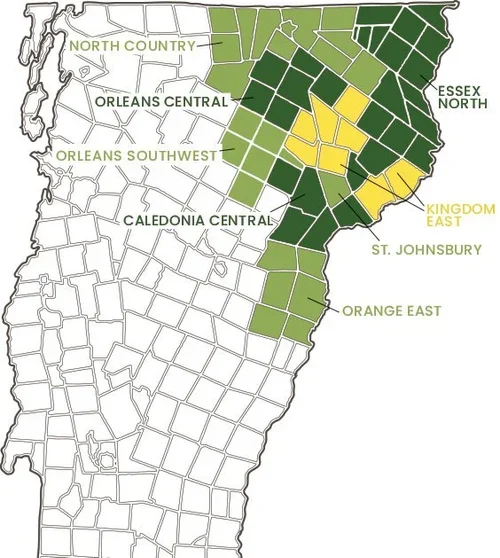
Pre-K through grade 12 educators from VREC member schools or SU/SD central offices are eligible to apply. Groups of up to three are eligible to apply for a grant at the same level of funding.
-
Grants of up to $2500 will be awarded. $2000 dedicated for the project and $500 of which is considered an honorarium.
-
For applications to be considered, all applicants must:
be employed by a VREC member SU, SD, or school.
indicate the intent to apply by Friday, February 20, 2026. Email John Castle at vrecdirector@gmail.com
participate in a brief “pitch” via Zoom to discuss their proposed project and receive feedback before final submission; and
submit applications by Friday, March 20, 2026 by 4:00 PM
-
Applicants are asked to propose a Place-Based Education project that will be completed by June 15, 2026.
Grant Timeline
Notice of Intent to Apply: February 20, 2026
Submit Application: March 20, 2026
Grant Recipients Notified: April 17, 2026
Grant Awards Provided: July 2026
Participate in Rowland Conference: Fall 2026
Complete Projects: June 15, 2027
Provide Project Summary: July 1, 2027
Honorariums Provided: July, 2027
-
Projects should involve supporting integration of place-based, community-based, and/or deeper learning into curriculum, instruction, and/or assessment so that students gain a better understanding and greater appreciation of their place and role as a citizen within the various communities they belong to (family, school, town, state, etc.). Similar to our Student-Led Mini Grant process, this could be achieved through actual classroom projects that address a community need, but is not required.
Proposals should include the following:
A problem of practice or promising practice to be addressed within a local context and/or focus of action research/inquiry
Professional learning goal
Student learning goal (e.g., learner-centered, inquiry-based, interdisciplinary)
Evidence of community as classroom and/or Democracy in the classroom
Timeline of project (for exploration & implementation)
Any deliverables, products and/or summaries/presentation for sharing with the field
Applications must include a short letter from their school principal acknowledging their support of the proposed project.
-
Design for Learning Curriculum-Instruction-Assessment
-
We look forward to supporting participants throughout the year and sharing their stories and final outcomes across Vermont. All participants will be expected to:
Attend and present at the annual Rowland Foundation Conference in the Fall of 2026 to share their project design and initial activities.
Five-person workshop where recipients present their proposals and plans.
Format: Boom Session - 8 minute Micro-presentation with facilitation from VREC.
Participate in a mid-year cohort “check-in” held virtually.
Complete projects by June 15, 2027 and provide a “presentation of learning” to their school community (ie. School Board, School Celebration of Learning, School or SU/SD Inservice).
Participants will provide a one-page project summary/report by July 1, 2027.
Jessica Applegate, 5th & 6th Grade Math and Science Teacher, Brighton Elementary School
I have proudly served the North Country Supervisory Union as an educator since 2002, including nine years in district leadership as the NCSU Director of Learning Design. Last fall, my passion for teaching led me back to the classroom, and I am currently a 5th and 6th grade science and math teacher at Brighton Elementary School. Prior to entering the public school system, I worked in adult outreach and school programming at a local environmental education and stewardship non-profit center.
I hold an Associate's degree in Communications and Public Relations, a Bachelor's in Elementary Education with a minor in Environmental Education, and a Master's in Curriculum and Instruction. I am a licensed Elementary Education teacher and Director of Curriculum and Instruction.
I live along the Clyde River with my husband and two college-aged children. I enjoy gardening, hiking, paddling, and skiing. Having raised my children in the Northeast Kingdom, I am deeply valued by the direct impact of working closely with local students, families, and colleagues, and I am honored to continue helping students build strong academic skills and a lasting appreciation for their environment.
Project Overview:
This planning initiative is focused on establishing a diverse committee to explore and design an expansion of place-based, outdoor learning opportunities beyond the current winter program. The committee, to be composed of our broader school community, will research best practices, gather stakeholder input, and develop a sustainable plan for integrating outdoor, experiential learning throughout the school year. Initial work will include surveys, site visits to successful programs, and building partnerships with local organizations to ensure programming reflects community resources and needs. The goal of this planning grant is to create a clear, actionable proposal for increasing outdoor learning experiences that support student engagement, well-being, and cross-curricular goals through connection to the local environment.
2026 Place-Based Teacher Innovation Grant Awards
Araceli Beauregard, 4th Grade Classroom Teacher, Barton Academy & Graded School
Currently, I teach fourth grade at Barton Academy & Graded School. In previous years, I’ve also taught third, fourth and fifth grades at Glover Community School as well as having taught third grade and special education at Derby Elementary. Although my teaching career stems from a B.A. in Elementary & Special Education and an M.A. in Curriculum & Instruction, I attribute most of my growth as an educator to having worked with the diverse population of learners that even rural areas like ours welcome into classrooms. I am local to the Barton area, where I live with my husband and two toddlers who keep me busy all hours that I’m not at school.
Project Overview:
After thoroughly studying life cycles, animal habitats, local ecosystems and the importance of pollinators, Barton students are so enthused to be installing a butterfly garden within a small alcove on the school playground! The garden will transform the outdoor space into a living laboratory, allowing students to study how plants, insects, weather, and seasonal changes interact in their own community. In addition to the planning, collaboration and responsibility required to carry out the project installation, the upkeep of the garden will demonstrate that ecosystems require ongoing attention and care. Barton Academy & Graded School is eager to bring more outdoor learning to our students and community while preserving our local pollinators in the process!
Dr. Sara Doncaster, Music Educator, Lake Region Union High School
I am the Music Educator at Lake Region Union High School. I teach Jazz Band, Modern Band, Chorus, Select Chorus and Music Theory. Prior to my position at LR, I was a PreK-8th grade general, choral and instrumental music teacher in the North Country district. I have a dual Bachelors Degree in Piano Performance/Theory & Composition, and a Masters and PhD in Theory & Composition. I am the director of the Warebrook Contemporary Music festival and I’m currently composing a quintet for Warebrook this summer, and two choral works for Social Band (Burlington, VT) for the 2026-2027 concert season. I live in Coventry and enjoy gardening, hiking, swimming and spending time with friends and family.
Project Overview:
During the summer and fall of 2026, I will be overseeing the retrofit of the LR TV Media Lab into a recording studio. This project was inspired by the singer/songwriters that have emerged from the music program, and my desire to provide vocational opportunities for musicians. Students will have the opportunity to be trained in basic audio engineering through a new course approved by the school board, “Audio Engineering 101” which qualified students can take for science credit. Students in the class will produce recordings of original songs. Ultimately, the studio will be completely student run. They will assist teachers, students and community groups with executing a range of recorded projects.
Theresa Peura, Library Media Specialist, Barton Academy and Graded School and Glover Community School
I have been working in the school system for five years following a midlife career change from the dairy processing industry. I still own and operate a small dairy farm in West Glover with my husband and four children. In addition to work in the education and agricultural fields, I am an artist exhibiting regionally in Vermont. My work both in and out of the classroom is founded on multidisciplinary curiosity and a love for research.
Emily Chilafoux, Art Educator, Barton Academy and Graded School and Glover Community School
I have been working in public education for over 10 years and have spent the last 8 years specifically at Barton and Glover. While I currently only teach art, I also have a library endorsement and a life long love of books. When I’m not teaching art, working on my master’s degree, or spending time with my family, you can find me at the bowling alley or the softball field.
Project Overview:
For the past three years we have been using students’ interest and abilities in Minecraft to develop their skills in resilient architecture and design to better prepare them to adapt to a changing world. The intention is to use familiar and readily available software to tackle hyper local problems and challenge students to think about their role in the built and natural environment while giving them an opportunity to use skills in school that may be both underutilized and unappreciated. VREC’s innovation grant will allow this work to continue and expand on it to include guided activities with Frank Lloyd Wright’s Taliesin Institute and digital rendering. We are very honored and excited to be able to develop this practice and provide these opportunities to students.
Jill Mudgett (She/Her), 8th Grade Global Citizenship Teacher, Hazen Union School
I have been teaching at Hazen Union School for three years, and enjoy working with students in their home community. I hold a PhD in American history and have published on the topic of place-based identities. A particular interest is the connection between people and the environment in rural New England, and I am very excited to bring conversations about sense of place into my 8th grade classroom.
Vaiva Velzis (they/them), Community School Coordinator, Hazen Union School
I am the Community School Coordinator at Hazen Union School, where I build strategic partnerships, expand student opportunities, and coordinate supports across students’ learning and lived experiences. My work centers on place-based, experiential learning, restorative practices, and student voice, rooted in a vision of transformative education. I look forward to engaging our 8th grade students as changemakers, serving as researchers, storytellers, and co-designers of their communities as they imagine and shape more just and expansive rural futures.
Project Overview
Vermont History: Mapping Identity, Memory, and Possibility in Rural Vermont is a place-based, inquiry-driven 8th grade social studies course that engages students as researchers, storytellers, and active participants in their community. Grounded in Youth Participatory Action Research (YPAR) and place-based learning, students explore questions of identity, history, and belonging by investigating their local context. Through interviews, fieldwork, creative projects, and community partnerships, students examine the past and present of rural Vermont while imagining possible futures.
The course integrates civic engagement, storytelling, and interdisciplinary learning, inviting students to connect personal experience with broader social and historical themes. Ultimately, the goal is to support students in developing a deeper sense of place, stronger relationships with their community, and a growing capacity to contribute meaningfully to it.
2025 Innovation Grants presented at Rowland Foundation Annual Conference
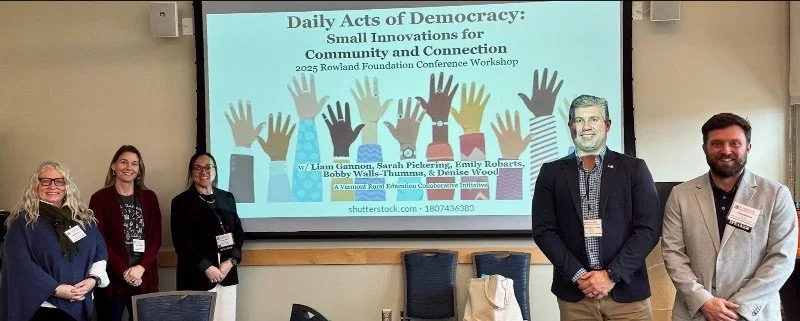
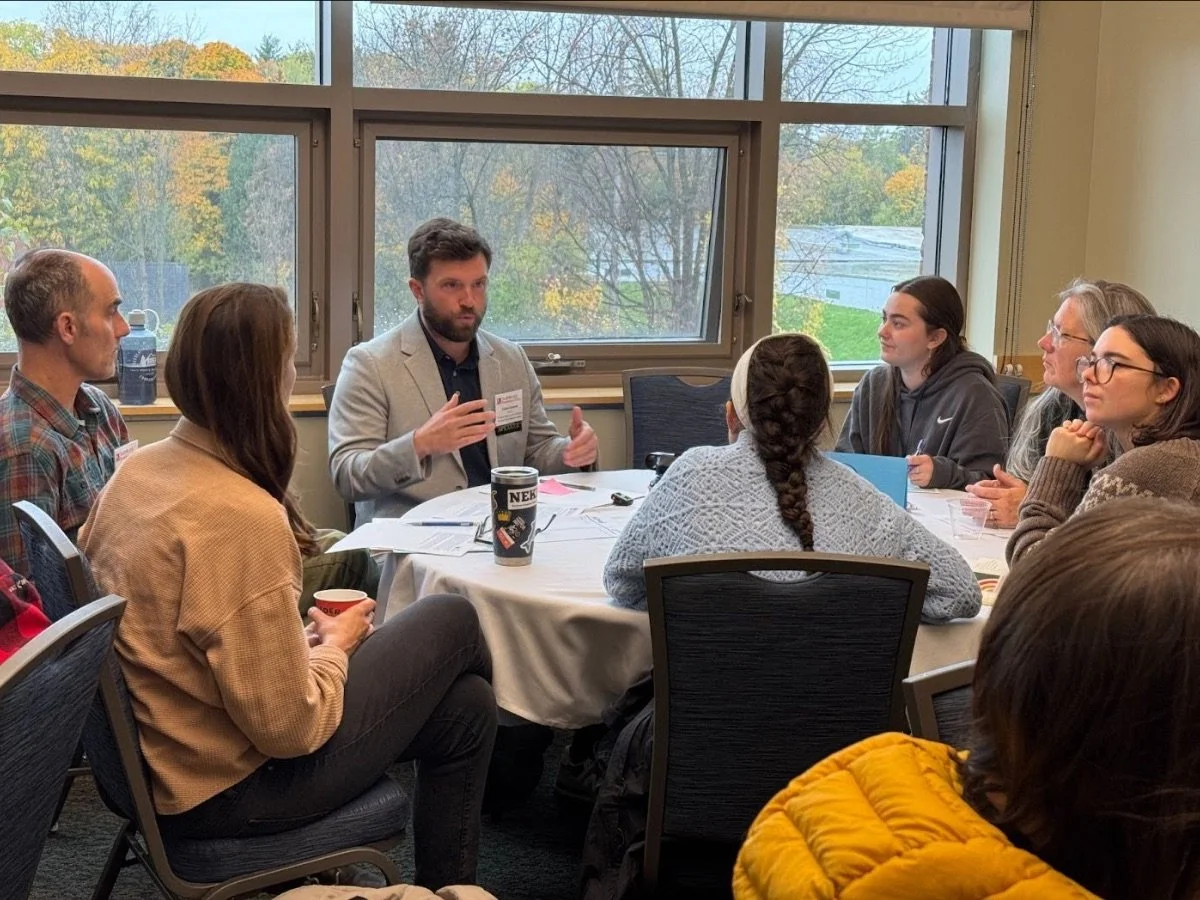
On October 30, 2025, five education professionals from four schools in the Northeast Kingdom of Vermont presented their workshop Daily Acts of Democracy: Small Innovations for Community and Connection to an interdisciplinary group of educators from around the state at the 14th Annual Rowland Conference held at the Davis Center on the UVM campus.
Emily Robarts (Waterford Elementary, CCSU), Denise Wood (Canaan Memorial High School, ENSU), Liam Gannon (Newport City Elementary, NCSU), and Bobby Walls-Thumma and Sarah Pickering (North Country Union High School, NCSU) shared how making small innovations in place-based education helps to engage students in daily acts of democracy.
From building telescopes so that students understand that space can be accessible to any citizen, to developing media production skills through podcasting to connect with community, to student-led civic action projects that address local issues, to building an outdoor classroom for the whole community, these educators spanning K-12 in the Northeast Kingdom shared their in-process pilot projects based on the premise that small innovations can result in big changes for student learning.
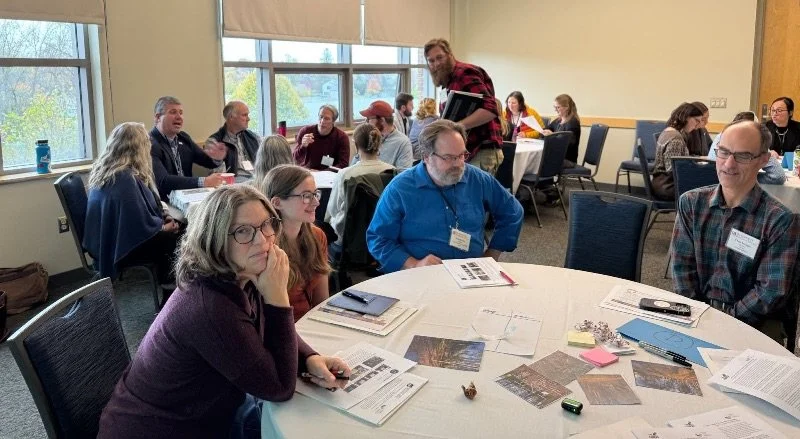
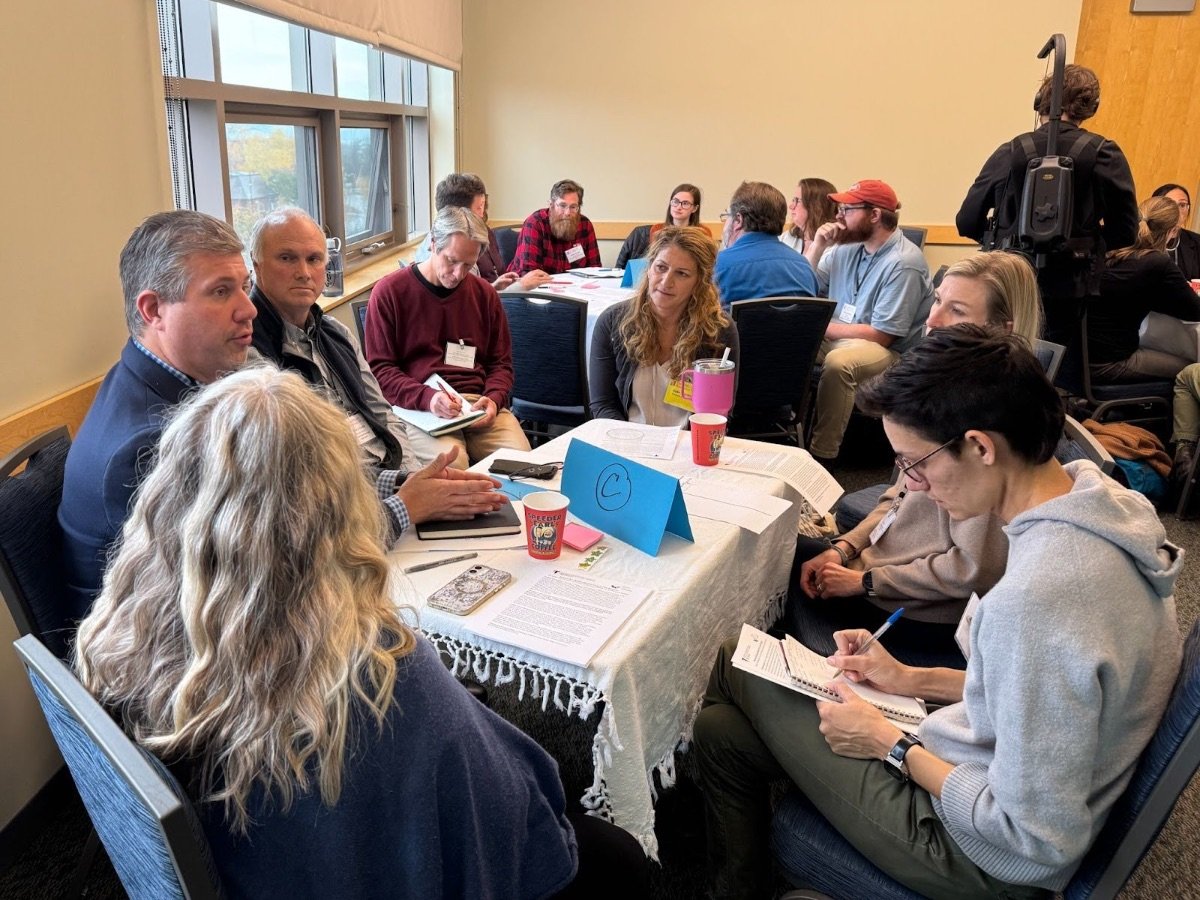
Each educator presented a short, six-minute “boom” session that shared important take-aways and posed a community question, after which participants were able to connect with presenters in four rounds of “speed-citizening” to make connections, share ideas, and engage in community problem-solving.
CCSU and NCSU were awarded Act 67 Community School grants in 2021 as part of Vermont’s first community school cohort, and ENSU joined Vermont’s second cohort of community schools in 2024 and is a recipient of the CCSC Community School sub-award for FY26 and FY27.
2025 VREC Place-Based Learning Innovation Grant Recipients
Denise Wood, Canaan Memorial High School
Teacher Bio:
I have taught at Canaan Memorial High School for the past six years. During my tenure, I transformed the traditional business curriculum into the Business Administration & Technology (BAT) CTE Program. This innovative program allows students to earn up to 21 college credits through dual-enrollment courses and gain hands-on, real-world experience through activities such as managing the school store. I am a passionate advocate for technology integration in education, I am a Google Certified Trainer and hold both Level 1 and Level 2 Google Certified Educator credentials. I am honored to recently be recognized as the Vermont Future Business Leaders of America Advisor of the Year.
Project Overview:
Canaan Schools is excited to launch a place-based learning project that will bring podcasting and digital media production into the classroom. This initiative involves the creation of a fully functional recording studio within the business classroom. The studio will provide students with the tools and technology to produce high-quality podcasts, which will be shared through an online radio station. Podcasting and online radio provide an accessible way for students to engage with the world beyond their rural setting while also highlighting the voices and experiences of their own community. This innovative project will give middle and high school students the opportunity to explore storytelling, journalism, and audio production while engaging deeply with their local community.
Testimonial:
“Receiving the VREC Innovative Teacher Grant allowed me to bring podcasting into my classroom, and the impact on students has been incredible. Through this project, students strengthened communication and teamwork skills while gaining confidence in their voices and ideas. I would strongly encourage educators to apply—this grant truly supports innovative learning that leaves students with lifelong skills.”
Emily Robart, Waterford Elementary School
Teacher Bio:
This is my fourth year teaching 2nd grade at Waterford Elementary School. Previously, I was directed and taught at local Montessori schools. I am passionate about hands-on learning opportunities and outdoor learning experiences. I enjoy spending time with my students outside through all the seasons. I live in Guildhall VT with my husband, our 3 children and 5 dogs! We enjoy many outdoor activities such as hiking, kayaking, biking, fishing and skiing/snowboarding.
Project Overview:
We will design and build an outdoor classroom space where students can take their learning to a prepared outdoor environment that supports their learning goals, along with their social and emotional development. We see the space as an opportunity for place based science and math explorations, a nature-inspired writing area, an area to create nature inspired arts and crafts and an outdoor play space that allows for children to use their imaginations, work together, practice problem solving, conflict resolution skills and have fun.
Liam Gannon, Newport City Elementary School
Teacher Bio:
I teach 6th-grade Science and Social Studies at Newport City Elementary School, where I've been for five years. Before that, I worked at Laraway School in Johnson, VT, and spent five years as an environmental consultant studying underground coal fires and fugitive methane seepages across the Rocky Mountain West, India, and Australia. My wife and I live in Troy with our one-year-old son, Harry, and our dog, Spudnik. Like many Vermonters, we love spending time outdoors—especially under our incredible dark skies.
Project Overview:
6th graders at NCES will design and build telescopes using hand tools, 3D printers, laser cutters, and small telescope components. These telescopes will be available for community use, both at home and at designated dark sky sites chosen by students in collaboration with community partners. Through these partnerships, students will advocate for reducing light pollution and educate telescope users on effective stargazing techniques. With such amazing viewing opportunities in the NEK, this project will inspire students to engage with astronomy and share the wonders of the night sky with the community.
Testimonial:
“The VREC Innovation Grant has proven to be the perfect opportunity for me to explore a part of my curriculum at a deeper level. The funding plays a huge part in that but even more valuable has been the time spent working with the rest of this year's cohort. The Rowland Conference was also a highlight, I left that experience feeling energized and motivated. Spending time with other educators stoked on their work is contagious!”
Bobby Walls-Thumma & Sarah Pickering, North Country Union High School
Teacher Bio – Bobby:
I teach Honors Government and Economics at North Country Union High School in Newport. I have served as an educator for 16 years, and prior to that, I proudly served my country as an intelligence analyst in the post-9/11 era. I hold B.A. in political science and international relations, an M.A. in history, and am currently nearing completion of a second master's degree in national security studies. When I'm not teaching or learning about politics, I am running North Country's Model United Nations team and serving as the varsity snowboarding coach for the state champion North Country Falcons. In my spare time I enjoy weightlifting, hiking, and spending time outdoors with my wife, 3 golden retrievers, and the myriad of farm animals that we have on our little slice of paradise in Coventry, Vermont.
Teacher Bio – Sarah:
I am the Director of Learning Design at North Country Union High School. In my current role I focus on supporting teachers with all aspects of teaching and learning as it relates to student achievement, social-emotional well-being, and professional growth. I am passionate about empowering our learning community to elevate their voices, lead by example, and advocate for self, others, and systems. Since moving to the NEK from Southern Vermont last summer, I have enjoyed renovating our new home, exploring the outdoors, and embracing a sustainable lifestyle.
Project Overview:
Falcons for Changes is an innovative, teacher-facilitated, student-led civic action project integrated into the Government & Economics course at North Country Union High School in Newport, Vermont. This project aims to engage high school students in addressing and solving real community issues within the Northeast Kingdom of Vermont. By combining academic learning with hands-on civic engagement, the project seeks to deepen students' understanding of government functions, promote active citizenship, and catalyze meaningful community change. By uniting people under shared goals and fostering collaboration across sectors, our civic action projects help to create thriving, equitable, and resilient communities.
Testimonial - Bobby:
“This year's VREC Innovation Grant has allowed me to take my class Civic Action Projects to a level that I didn't think was originally possible in our rural area. The funding has provided my students the opportunity to pursue their projects with increased rigor and relevance by opening up exciting new opportunities for engagement with their local communities. Along with the funding, the built-in network of professional educators that the grant provides has led to wonderful professional collaborative sessions, including the opportunity to present at this year's Rowland Foundation Conference, all of which has led to more robust processes and project outcomes for my students.”